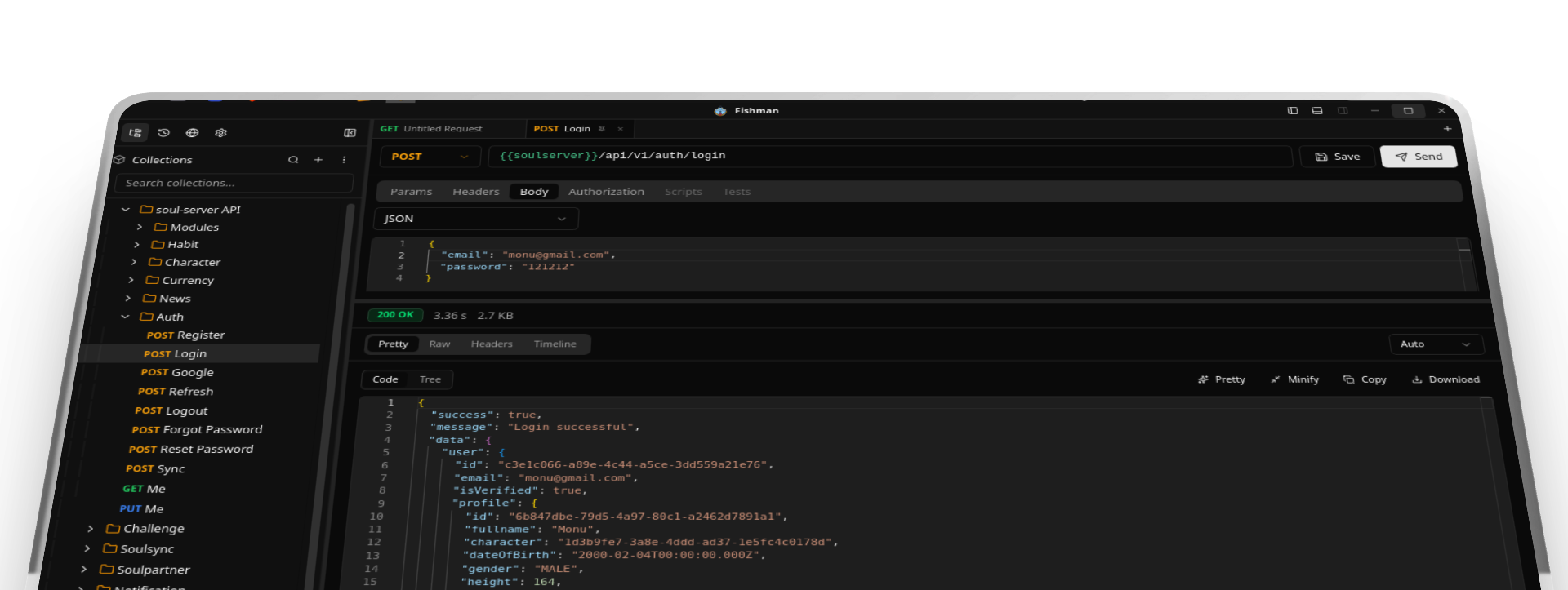
Native Performance (<50MB RAM)
Built on Tauri v2 and compiled Rust (reqwest + tokio-tungstenite). Sub-second startup, minimal memory, zero Chromium overhead.


Release v0.1.2 · Open Source Apache-2.0
No cloud accounts. No Electron bloat. Fast native Rust HTTP, multi-language backend route scanning (Node.js, Go, Rust), Git-native collections, GraphQL, WebSockets, and Scan Drift sync.
Release · v0.1.2
Linux and Windows 64-bit builds are ready. Featuring GraphQL with Monaco & Introspection, OpenAPI 3 / Swagger Spec Link, Scan Drift sync, Git-native workspaces (*.fish), and built-in terminal. Pick your platform below — macOS is coming soon.
Windows builds are 64-bit (x64) only. 32-bit is not supported.
macOS builds are coming soon — follow the repo for updates.
Built for speed, privacy, and flow. A native, local-first API IDE that lives directly in your Git workflow.
Built on Tauri v2 and compiled Rust (reqwest + tokio-tungstenite). Sub-second startup, minimal memory, zero Chromium overhead.
Collections live in your Git repository as human-readable .fish JSON. Branch, review pull requests, and commit API changes alongside your application code.
Automatically inspects Node.js, Go, or Rust backend source code and generates ready-to-test API collections without manual entry.
Kept in sync with your code over time. Safely updates modified routes while preserving your custom headers, tokens, and test scripts.
Seamlessly switch between REST (including HTTP QUERY), GraphQL (with schema introspection), and real-time WebSockets in the same tabbed workspace.
Connect live specs from URL or file. Sync changes without blowing away existing tests or manual customizations.
Everything you need to build, inspect, and test APIs — with local-first speed.
VS Code-style Ctrl/Cmd+Shift+H to bulk-swap base URLs across requests with whole-origin protection.
One-click detection of PORT, BASE_URL, and tokens into isolated public and secret environments.
Run backend servers, tests, or curl commands directly inside Fishman’s bottom tools panel.
Live debugging table inspecting timing metrics, HTTP status codes, headers, and payload sizes.
Export instant, responsive, offline HTML documentation for your API collections with a single click.
Requests stored as deterministic, human-readable .fish JSON files in git with auto-gitignored secrets.
Monaco query & variables editor, operation selector, schema introspection explorer, and split data/error views.
Persistent spec link with non-destructive surgical sync that preserves user headers, test scripts, and locks.
Visual diff (Added, Changed, Removed) & safe merge keeping collections aligned with Node.js, Go, and Rust code.
Connect to ws:// and wss:// endpoints with a live message timeline, color-coded frames, and templates.
Built with Tauri v2 and Rust HTTP engine for <50MB RAM footprint and sub-second cold starts.
Work on multiple requests simultaneously with request history, split views, and instant execution.
{{variable}} substitution across URLs, headers, params, and bodies with scope hints and secret masking.
Bearer, Basic, API Key, JWT, and OAuth2 tokens with automated header injection.
Syntax-highlighted JSON tree, raw text, headers, and preview tabs powered by Monaco Editor.
App-wide shortcuts, Quick Open palette, and zoom controls designed for maximum developer flow.
Looking for an open-source Postman alternative? Here’s an honest look at how Fishman compares with Insomnia, Bruno, Hoppscotch, Thunder Client, and Apidog — focused on privacy, locality, and developer flow.
| Capability | Fishman | Postman | Insomnia | Bruno | Hoppscotch | Thunder Client | Apidog |
|---|---|---|---|---|---|---|---|
| Open source | Yes (Apache-2.0) | No | Partial | Yes | Yes | No | No |
| Local-first / Git-native | Strong (Git-native .fish + SQLite) |
Cloud-centric by default | Local + sync options | Git-friendly local files | Web + self-host | VS Code local | Cloud + desktop |
| Native desktop runtime | Tauri v2 + Rust (<50MB RAM) | Electron (>500MB RAM) | Electron | Electron | Web-first | VS Code extension | Electron |
| Backend code → collections | Yes (Node.js, Go, Rust scanner) | Manual / import | Manual / import | Manual / import | Manual / import | Manual | Design/import focused |
| Scan Drift & code sync | Yes (visual diff & merge) | No | No | No | No | No | No |
| GraphQL IDE | Yes (Monaco + introspection) | Yes | Yes | Yes | Yes | Limited | No |
| OpenAPI / Swagger sync | Yes (Spec Link & surgical sync) | Import only | Import only | Import only | Import only | Import only | Yes (cloud) |
| WebSocket support | Yes | Yes | Yes | No | Yes | No | Yes |
| Find & Replace URLs | Yes (Ctrl/Cmd+Shift+H) |
Manual / find | No | No | No | No | Limited |
| Built-in PTY terminal | Yes | No | No | No | No | No | No |
| Documentation generation | Yes (1-click offline HTML) | Yes (cloud hosted) | No | No | No | No | Yes |
| Postman import/export | Yes (lossless) | Native | Yes | Import paths vary | Yes | Limited | Yes |
Fishman is a native, Git-first alternative to Postman and Insomnia with Bruno-like local privacy — plus AST backend route scanning, Scan Drift sync, and GraphQL.
Native support for REST, GraphQL, WebSocket, OpenAPI 3 Spec Link, and AST backend scanning — all inside one local-first IDE.
Full HTTP method set (including QUERY), parameters, multipart/form-data, raw JSON, Bearer/Basic/JWT/OAuth2 auth, and code generation.
Available now
Query, mutation, and variable editors powered by Monaco Editor, operation selector, schema introspection explorer, and split data/error views.
Available now
Connect to ws:// and wss:// endpoints. Live message timeline, bidirectional frame logging, text/JSON/binary composer, and reusable templates.
Available now
Connect via URL or file. Spec Link maintains persistent synchronization with upstream contracts through non-destructive surgical diffing.
Available now
AST code-first route discovery for Express, NestJS, Fastify, Gin, Echo, Chi, Actix Web, and Axum — with visual drift diffing and safe merge.
Available now
API-as-Code (.fish), deterministic JSON, secret isolation (*.secret.json), and built-in Git diff and conflict resolution.
Available now
Fishman is moving fast. Here’s what’s shipped in v0.1.2, what’s in active development, and what’s next.
.fish JSON)Ctrl/Cmd+Shift+H).env)fishman run)Fishman is evolving from an API client into an intelligent, Git-first API IDE.
Import/export and scanning are designed to be extensible. Node.js, Go, and Rust scanners are live in v0.1.2 — Python and Java are currently in progress.
Storage: Git (.fish) + SQLite · License: Apache-2.0 · Privacy: 100% Local-First
Fishman is 100% free and open-source software licensed under the Apache License, Version 2.0.
Fishman is free, open source, and community-driven. Inspect the code, fork it, or contribute improvements directly on GitHub.
100% local-first and offline-capable. No cloud account required, no forced tracking, and zero vendor lock-in.
Quick entry points into setup, scanning, collections, and the workflows you’ll use daily.
Install, run, and ship your first API workflow locally.
Scan backend code into routes, request bodies, and collections.
Organize requests with nested folders and fast replayable history.
Coming soon — until then, use the app workflow.
Endpoints and request/response details.
Prerequisites and production build commands.
Quick answers about Fishman as a Postman alternative, local-first privacy, and protocol support.
Yes. Fishman is an open-source (Apache-2.0), local-first API IDE for REST, GraphQL, and WebSocket testing — a lightweight Postman alternative with sub-second startup, low memory footprint (<50MB RAM), and automatic backend code scanning.
Like Bruno, Fishman keeps all data local and Git-friendly. Like Insomnia, it offers a focused desktop UX. What sets Fishman apart is its native AST code scanner (Node.js, Go, Rust), Scan Drift synchronization engine, and Git-native .fish files with isolated secrets.
Fishman saves your API collections as clean, deterministic .fish JSON files right inside your repository. Sensitive environment variables live in separate *.secret.json files that are automatically gitignored, allowing your team to branch, commit, and review API changes in Git pull requests.
When your backend source code changes, Fishman’s Scan Drift engine compares live code against your collection and presents an actionable visual diff (Added, Changed, Removed). You can safely merge new or modified routes without overwriting custom headers, tokens, or test assertions.
Yes, both are fully available in Fishman v0.1.2. The GraphQL IDE features dedicated Monaco query and variables editors, operation name selector, and automatic schema introspection. The WebSocket client provides real-time bi-directional frame inspection, timeline filtering, and message templates.
Yes. You can link OpenAPI 3.x and Swagger 2.0 specs from a URL or local file. With Spec Link, click OpenAPI Sync at any time to re-fetch the upstream contract and apply a surgical diff that keeps your manual test scripts and headers intact.
Yes. Fishman provides lossless import for Postman v2.1 collections and environments, plus two-way export to Fishman or Postman JSON formats.
Completely. All collections, environments, history, and settings live locally in SQLite and your Git repository. Fishman operates 100% offline without requiring an account or cloud login.
Point Fishman at your project directory. Its AST scanner inspects source code in Node.js (Express, NestJS, Fastify, Koa, Hapi), Go (Gin, Echo, Chi, net/http, Fiber), and Rust (Actix Web, Axum) to discover route mounts, HTTP methods, and parameters, generating ready-to-test collections instantly.
Yes. Fishman is 100% free and open source licensed under the Apache License, Version 2.0. You can inspect the code, fork it, or contribute on GitHub.
Yes. Fishman includes an integrated PTY terminal for running servers and curl commands, plus a live Network Inspector table for inspecting HTTP status codes, durations, headers, and payload sizes.
Full documentation lives at nkrider7.github.io/fishman-docs, covering installation, getting started, backend scanning, and collections.
Local-first API testing
Open-source native API IDE that discovers routes, scans your backend, and generates ready-to-test collections in seconds — without forcing a cloud workspace.